Amite City is the seat of government for Tangipahoa Parish, Louisiana. Before it was Tangipahoa the area around Amite was in the parish of St. Helena and in fact Tangipahoa was created from four existing parishes. But what about Amite? Was it ever known by a different name or has it always been Amite City?
Years ago, I was at the LSU archive looking through old correspondence (from 1870s -1880s) about Amite and vicinity. I found a letter written by a woman stating that Amite was not always known as Amite, but at one time was known as Fillmore. Was this indeed true? How did that happen?
Amite City arose because the New Orleans and Jackson Railroad named one of its stops Amite Station. Amite was chosen because of the Amite River. . Thankfully some of the early railroad excursions across the lake were described by New Orleans newspapers. Articles describe the country near Amite Station and various activities taking place there. These activities give insight into the naming of the town.
In the late 1840s excitement began to build for a railroad that would travel south from Jackson, Mississippi, to the bustling port city of New Orleans, Louisiana. By 1849 public meetings were being held in Louisiana and Mississippi to discuss the railroad and a possible route. The two states formed commissions, chose delegates, and officially started studying and assessing a railroad.
To many people from Louisiana it only seemed logical that a railroad, from Mississippi, should terminate in Madisonville, Louisiana, and from there steamboats would ship the railroad cars and passengers across Lake Pontchartrain to New Orleans. Madisonville could also easily develop needed port facilities. Boats already plied the waters between there and New Orleans. In newspaper accounts this seemed the logical thing to do. In New Orleans the route would then connect to the existing Pontchartrain Railroad.
As time passed a route around the eastern edge of Lake Pontchartain was also being proposed. In 1850 it was noted that a rail line could go down either side of the Pearl River and across the Rigolets at Forts Pike and McComb. This would allow access into the heart of Mississippi and give connections to Alabama and to Atlanta, Georgia.
In January of 1850 a bill was introduced, in the Mississippi legislature, to incorporate the New Orleans and Jackson Railroad.. Although people supported the idea money and the political support had to be garnered. Different factions moved to solidify support and capital .
The people in Mississippi weren’t enthusiastic about a railroad that connected to a point above New Orleans and then to depend upon water to move the train cars across the lake. It too was believed that New Orleans was not that enthusiastic in support of the endeavor. It was thought that New Orleans should built the railroad up to the state line and from there Mississippi would take responsibility. Politicians in other parts of Louisiana were claiming that the state should direct funding to more needed areas and that New Orleans should fund the railroad. All of this was taking place and a final route had not even been determined.
The politics, funding, and support all moved forward on different fronts. Later a route on the western shore of Lake Pontchartrain started to be considered. This route was known as the River Route. The New Orleans newspapers began to publish articles from factions supporting the River Route and those supporting the Madisonville and Lake Route. Finally, in April of 1851 all the surveys had been conducted, and the engineers were ready to make recommendations. A large meeting of delegates was held in New Orleans to hear and discuss the recommended route.
The official recommended route was the River Route on the western shore of Lake Pontchartrain. This, of course, was not popular with some as this route was longer and more expensive that all the other routes? What about Madisonville, and Covington? What about the Pearl River route? The St. Tammany delegates withdrew from the convention to hold their own meeting about the proposal. After much back and forth the recommended River route was adopted and supported by all delegates.
With the route decided the railroad began construction along with needed train stops and other facilities. North of New Orleans, some sixty eight miles distant it was determined that this would be the first overnight stop for the train. This meant that passengers would have to find places to sleep and spend the night and to eat and to shop and to have things to occupy their time. The railroad stop, at this place, was named Amite Station. Although no town existed it was assumed that growth would take place there. Trains leaving New Orleans would stop for the first night at Amite Station and trains arriving from the north would stop at Amite Station as the last stop before going to New Orleans the next morning.
 |
| A Currency Note Depicting the New Orleans, Jackson & Great Northern Railroad |
The New Orleans and Jackson Railroad soon began to run excursions from New Orleans and to promote the country through which the road traveled. In the Nov. 11, 1854 issue of the Picayune an article describes an excursion to Osyka, Mississippi, and on this journey the train passed through Amite.
…The most gratifying sight as they were whirled along, was the frequent occurrence of new buildings springing at different points along the road, the sites of new towns, of which our readers doubtless remember the christenings only a few months since. Everywhere the people appear to have gone to work in earnest and with full faith in the success and the benefits of the road. Passing Amite the scene there was quite animating. A fine large hotel, with its spacious piazzas, looked quite town-like, some freshly built new houses and stores were scattered about, and at the station, waiting to start for the city was a locomotive with a train of cars loaded with cotton and other produce…
A town at Amite station was growing but no action had taken place for incorporation. Then in the August 2, 1856, edition of the Daily Picayune, an article appeared regarding an excursion to Amite Station by some 50 prominent people from New Orleans. They joined another 20 or so local citizens to discuss the future of the railroad and the town to be built. The excursion lasted two full days and the countryside was explored and a fishing trip to the Tangipahoa River took place. The article goes on the say:
…At the Amite station, about sixity-eight miles from the city, there is a large tract of land purchased by Messrs. W.H. Garland, Jno. M. Bach and S. Coleman, for the purpose of creating there a town. As a beginning, a store has been established which has already a good country trade, and the frame of a large, two-story hotel has gone up, and will soon be completed. Here the party regaled upon an ample and sumptuous supply of refreshments and comforts for the “inner man,” which they had brought with them from the city—their dining table being spread out beneath the shade of a magnificent oak. Here too, free from mosquitoes, and in the cool country air, they pitched their tents for the night…
The next day;
…A feast was prepared under the oak, and all were seated and in the full enjoyment of the bounteous repast, when the heavens clouded over and the thunder began to roll. The company continued to eat, with the stout confidence that it would not rain at all—that it would not rain much—that it would sprinkle and pass over, and that the stout and thick shelter of the oak would be sufficient. But down it came at last, with such fierceness and force that the tables were deserted, and the whole party were driven hastily to the house. They had pretty well satisfied their appetites for food, but the hosts were determined that the anticipated conviviality should not be thus frustrated. In a short time the tables were respread in the house; the wine bottles garnished it in unrestricted profusion; Col. Wm. Christy was made presiding officer at the head, and the ceremony of inaugurating and naming the new town was duly performed. Col. Christy, to whom had been referred the selection of its name, being called for, stood up, and prefacing it with a speech replete with classical allusions as to the ceremonial on such occasions, named it ‘Fillmore”—Fillmore City, we think he called it, but the additional word spoils it, and will, we hope, be not retained. There was, in course, the usual, and more perhaps than the quantity usual on such occasions, of toasting and speech making, some of which was really eloquent. The hilarity continued late and long, marked throughout with genial and cordial good humor, which made it a very delightful reunion, and not disfigured in any point by excess, a syllable of discord or ill humor….
Why would Col. Christy name a place Fillmore? Christy was a popular businessman and politician, from New Orleans. He was also an active leader of what was left of the Whig party in the United States during the 1856 presidential election. Millard Fillmore, who had previously served as president, was on the ballot again heading a third party effort with the American Party. The voters around the new growing town were very supportive of Fillmore for another term as president. In fact a great gathering would take place soon in the new town supporting Millard Fillmore. In the end Millard Fillmore carried the parishes of St. Helena and St. Tammany and Orleans but he garnered only 8 electoral votes nationwide. So, our fair town started out with the name of Fillmore but that name was never acted on officially. After Fillmore’s loss in the election enthusiasm for the name began to wain very fast.
Roughly one month after the ceremonial meeting mentioned above Mr. C.S. Stewart communicated to the editors of the Picayune. He stated that on September 16th there would be a Grand Barbecue at this place in order for the citizens to hear the Hon. P. Pond address the people regarding the candidacy of Fillmore. A special train would be coming from New Orleans for those in the city wishing to attend the event. The heading of the brief article was “Fillmore Meeting at Amite.” The address read “Amite Station, N.O., J.&G.N.R.R.
The September 17, 1856, Daily Creole Newspaper said the following about the meeting:
…At the station a procession was formed, which marched to the ground, some three-quarters of a mile distant from the Amite City Hotel—a beautiful spot in the midst of the pine forest, whose foliage made a refreshing shade. We found the area in front of the stand well filled with ladies, who evinced no little interest in the discussion which was to take place in regard to the questions now agitating the country.
The assemblage, including the ladies, numbered about twenty-five hundred, embracing, as we were told every family within thirty miles of the place.—Such an audience, gathered at this place, is an indication, which cannot be mistaken, of the zeal and enthusiasm of the people for Millard Fillmore—for we venture the assertion, that not forty in that large assembly were in favor of Buchanan…
The article went on to say that the Buchanan delegate could only muster a few shouts and claps while the Fillmore delegate had such shouts that could be heard for miles though the pristine forest.
Even though Amite City started to emerge during much political zeal for Millard Fillmore - the zeal did not continue. Now if he would have won the election perhaps things would have been different. It is worth mentioning that some men in the area, born at this time, were named Millard Fillmore. Now we know why!
In April. of 1861 the articles of incorporation for Amite City were approved by the Louisiana legislature. The name of Amite City was already being used by the US mail at this time. Amite City was chosen to differentiate the town from Amite County, Mississippi and from the Amite River. Amite became the dominant name used for the town - and to me that sure sounds better than Fillmore?
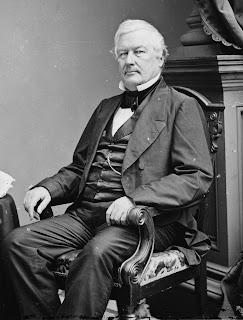 |
| Millard Fillmore |
Millard Fillmore was the 13th President of the United States. He was elected Vice President during the 1848 election and assumed the presidency in 1850 after the death of Zachary Taylor. Fillmore was the last Whig President. He was not nominated by the Whigs for the 1852 election and the party disintegrated before the 1856 election. However, for the 1856 election Fillmore was nominated by the American Party while he was out of the country.